BioProtect Marine Planner |
349611
wp-singular,portfolio_page-template-default,single,single-portfolio_page,postid-349611,wp-theme-moose,wp-child-theme-moose-child,cookies-not-set,eltd-cpt-2.4,ajax_fade,page_not_loaded,,moose child-child-ver-1.1,moose-ver-3.6, vertical_menu_with_scroll,smooth_scroll,blog_installed,wpb-js-composer js-comp-ver-7.1,vc_responsive

BioProtect Marine Planner

Project Description

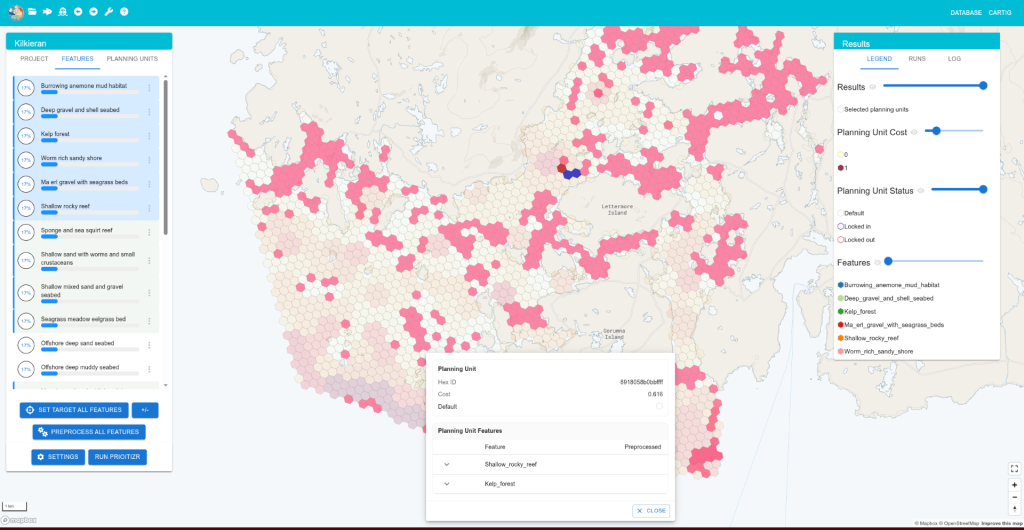
The BioProtect Marine Planner is a web-based conservation planning support tool developed under the EU-funded BioProtect project (Grant Agreement 101157341). It enables users to identify case-specific areas of priority for conservation in the marine environments, based on human activities, cumulative impacts and biophysical data. The tool supports the establishment of conservation areas, such as MPAs or other spatial conservation measures. The tool is designed on an interconnected multi-scale grid that allows large-scale and small-scale events to be mutually influenced.  

It includes a stakeholder engagement platform that allows collaborative planning process via the collection of spatial local knowledge, updating planning scenarios on the main app.  

All data is stored on a unique server that informs all components – biodiversity features, human activities, pressures, costs layers, grid – supporting evidence-based and collaborative conservation decision-making.

WHO WE ARE
  • Regional or local (public) authority;
  • NGOs, foundations (public and private), professional association, community-based organisations including civil society and citizen associations;
  • SMEs and Large Entreprises;
  • Cultural and Educational organisations;
  • Research organisations and academia;
COUNTRY & REGION

Norway, Iceland, Ireland, Portugal (North-East Atlantic)

DURATION

From Year 2024 to Year 2028
Number of Months: 48 

KEY WORDS
  • Marine Conservation Planning
  • Spatial Decision Support
  • Cumulative Impacts 
CHALLENGE & OBJECTIVE

Marine ecosystems face growing threats from climate change, pollution, overfishing, coastal development, and other human activities. Despite increasing policy ambition — such as the EU Biodiversity Strategy 2030 target to protect 30% of seas — decision-makers and marine spatial planners often lack accessible, integrated tools to identify where conservation efforts will be most effective. 

Existing tools for systematic conservation planning tend to require significant technical expertise, are not web-accessible, and do not allow stakeholder knowledge to communicate with formal data. This creates a gap between conservation science and practical implementation. 

The primary objective of the BioProtect Marine Planner is to bridge this gap by providing an intuitive, web-based platform that: (1) visualises costs of the presence or absence of conservation solutions in a case-specific workflow; (2) harmonises dense spatial data necessary for conservation planning — including biodiversity features, human activities, pressures, planning grids, and cost layers; (3) runs optimised conservation solution  algorithms to identify priority areas; and (4) enables local knowledge to directly contribute to conservation planning through a participatory data collection interface. 

The tool supports marine planners and managers, local and regional authorities, as well as researchers in making evidence-based decisions on where and how to establish or expand MPAs and other area-based conservation measures. 

SOLUTIONS & ACTIONS

The BioProtect Marine Planner uses an iterative co-design process throughout its development. When a prototype has been conceived, it is tested during in-person workshops with stakeholders and potential end-users to gather feedback on tool suitability and clarity. This has been done in Ireland (country of development) and will be spread in other case studies across the Northeast Atlantic.

The tool will also be brought to small-scale communities during community events to 1) raise awareness and build capacity for collaborative conservation planning amongst small-scale stakeholders 2) collect further spatial data and feedback on the tool and 3) reach out to small-scale planners who constitute potential end-users; thus spreading the use of the tool across all relevant scales and cases.

Once adopted, the BioProtect Marine Planner will support the designation of novel or extended MPA network across all regions.

END USERS

Primary end users include: marine spatial planners and national/regional marine authorities; marine protected area (MPA) managers; conservation scientists and researchers; environmental NGOs and consultancies; and policymakers at EU and national level.

COMMUNITY ENGAGEMENT


NEEDS

The BioProtect Marine Planner supports case-specific and area-based conservation solutions by following collaborative processes. The tool collects and analyses local challenges through formal and informal spatial data and generates solutions tailored to the chosen scale for the planning process. It also facilitates dialogues between decision-makers and communities by simplifying the showcase of planning scenarios and updating the latter directly with stakeholders.

In Ireland, Norway, and other use-cases adopting the BioProtect Marine Planner, conservation implementation has been slow due to the complexity of harmonizing the data to create coherent plan, and due to the difficulty to effectively dialogue with communities on concrete actions. The tool fully bridges the above challenges, ensuring conservation is community-informed.

Engagement measures include open meetings, volunteer workdays, partnerships with local groups, regular communication, recognition of contributions, and inclusive forums for feedback and co-design.

Communities benefit from increased environmental knowledge, stronger social networks, enhanced wellbeing, new skills, and a shared sense of ownership over restored natural spaces.


MEASURES

  • Demonstration workshops at the five BioProtect sites with local marine authorities, fishers, and NGOs to gather feedback on tool suitability and clarity
  • Communities of Practice (CoPs) established within BioProtect to gather ongoing user feedback and ensure the tool reflects real stakeholder needs;
  • Integration of PPGIS (Public Participation GIS) outputs from the broader BioProtect platform into the Marine Planner datasets.
  • Capacity-building workshop to train end-users in adopting the tool for their planning project/scale


BENEFITS

Communities will benefit from: (1) greater transparency in conservation planning decisions that affect their livelihoods and marine access; (2) a formal mechanism to contribute local ecological knowledge into spatial planning, giving their input scientific and policy visibility; (3) improved marine governance outcomes, as plans based on integrated local and scientific knowledge are more likely to be effective and supported by communities; (4) access to a free, open web tool that empowers local managers and authorities to conduct their own preliminary conservation planning analyses.

OUTPUTS

The outputs of the tool are designation of new or reformed areas of conservation more adapted to both biophysical and socioeconomic reality of local, regional and international realities of marine ecosystems. It introduces more effective governance models and regulations accelerating conservation efforts.

Additionnally, the use of collaborative tool development and planning processes empowers communities and encourages further and simplified integration of informal knowledge and community-informed measures in conservation frameworks.

OUTCOMES
  • Environmental impacts: Improved identification and designation of marine protected areas and effective area-based conservation measures; better understanding and mapping of cumulative human pressures on marine biodiversity; contribution to EU and national targets to protect 30% of marine areas by 2030
  • Economic impacts: More efficient use of conservation budgets through spatial prioritisation tools that identify high-value conservation areas with lower conflict costs; potential reduction in costs associated with poorly-planned MPAs that generate community resistance; support for sustainable blue economy activities by clearly delineating protection zones
  • Social impacts: Enhanced participation of coastal communities, local authorities, and civil society in marine spatial planning; greater transparency and legitimacy of MPA designation processes; improved trust between conservation bodies and marine stakeholders through co-designed planning tools
Project Details
Category

Community-Led Pilot Action Use Case Scenarios

Previous
Next