
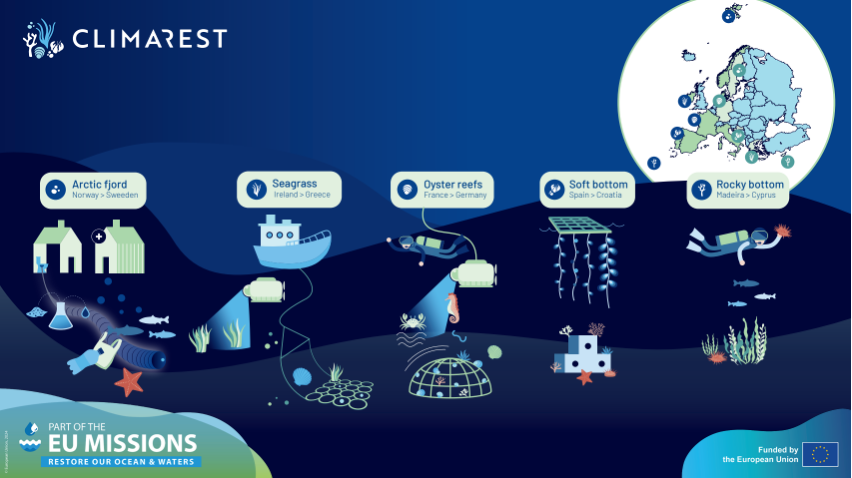
This case illustrates how strategic roadmaps were developed to support replication and upscaling of restoration solutions (for oyster reefs, seagrass meadows, sedimentary soft-bottom habitats, rocky reef systems and Arctic fjords) in multiple European regions. The roadmap process focused on enabling replication across institutional, environmental and regulatory contexts rather than implementing restoration actions. It applied a structured methodology across demonstration–replication pairs to identify shared constraints, enabling conditions, financing needs, governance roles, monitoring requirements and innovation pathways. Through co–creation workshops, paired meetings and cross–habitat analyses, the process identified systemic barriers such as fragmented permitting, short project cycles, limited monitoring continuity and gaps in financial readiness. It also outlined strategic actions across governance, financing, data and monitoring, and innovation to support long–term implementation. The roadmaps provide guidance for replication sites to adapt solutions to local contexts and contribute to planning aligned with the objectives of the EU Mission “Restore our Ocean and Waters.”


Roadmaps for replication of demonstration sites
Project Description
WHO WE ARE
- Regional or local (public) authority
- NGOs, foundations, community-based organisations
- Cultural and Educational organisations
- Research organisations and academia
COUNTRY & REGION
Multiple European regions participating in CLIMAREST replication (Sweden, Greece, Germany, Croatia, Cyprus).
DURATION
From Year 2023 to Year 2025
Number of Months: 30
KEY WORDS
- Roadmap
- Replication
- Restoration
CHALLENGE & OBJECTIVE
The roadmap process addressed challenges linked to institutional, environmental and regulatory differences that affect the ability to replicate restoration solutions. Its primary objective was to identify shared constraints such as fragmented permitting, short project cycles, limited monitoring continuity and financial readiness gaps. By analysing these barriers and the conditions needed to overcome them, the roadmap aimed to support regions in preparing for replication and long–term implementation of restoration approaches.
SOLUTIONS & ACTIONS
A structured methodology was applied to support replication and upscaling. This included working across demonstration–replication pairs to identify shared constraints, enabling conditions, financing needs, governance roles, monitoring requirements and innovation pathways. Co–creation workshops and paired meetings were used to organise discussions, and cross–habitat analyses helped highlight systemic barriers such as fragmented permitting, short project cycles, limited monitoring continuity and financial readiness gaps. The process also identified strategic actions across governance, financing, data and monitoring, and innovation to support longterm implementation. These actions were designed to help replication sites adapt restoration solutions to their own contexts and to support broader planning efforts.
END USERS
Regional authorities, policymakers, environmental managers, research organisations, NGOs and others involved in planning or coordinating restoration activities.
COMMUNITY ENGAGEMENT NEEDS, MEASURES & BENEFITS
Communities needed clarity on the conditions required for replication, including restoration practices, monitoring expectations, regulatory processes and long‑term planning. The roadmap addressed these needs by identifying the factors that influence replication and by outlining how solutions could be adapted to different regional contexts.
Engagement was ensured through co‑creation workshops, paired meetings and structured discussions across regions. These activities allowed stakeholders to participate in identifying constraints, needs and enabling factors for replication.
Communities benefit from clearer planning pathways, better understanding of regulatory processes needs and improved ability to prepare for and support future restoration efforts in their regions.
OUTPUTS
Outputs include identification of constraints, enabling conditions, governance needs, financing needs, restoration processes and innovation pathways that support replication and upscaling.
OUTCOMES
- Environmental impacts: Supports future restoration efforts by helping regions plan for replication.
- Economic impacts: Clarifies financing needs and readiness gaps relevant for long‑term implementation.
- Social impacts: Improves understanding of governance roles and increases community readiness for future restoration activities
Project Details
Category
Transition Agenda Use Case Scenarios